What Drives Shipping Container Prices in Ontario
Container pricing isn’t set in a vacuum. Several factors push prices up or down, and they interact in ways that aren’t always obvious at first. The global supply of used containers, the Canadian dollar’s strength against the USD, and local demand in Ontario all play a role, and from what we’ve seen, buyers who understand these variables tend to make better purchasing decisions and avoid sticker shock at checkout.
Condition is probably the biggest single variable. A container graded “cargo worthy” is priced at a premium over one that’s simply wind-and-watertight. And new or one-trip containers sit at the top of the price range, for good reason.
Standard Price Ranges for 2026
For most Ontario buyers in 2026, used 20-foot containers are being quoted in the $2,500 to $4,500 CAD range. Used 40-foot units generally fall between $3,800 and $6,500 CAD. New or one-trip containers, in either size, tend to run higher, sometimes significantly so.
Prices for shipping containers for sale have stabilized somewhat compared to the volatility seen in 2021 and 2022. But pre-pandemic lows haven’t been returned to. So bargain pricing shouldn’t be expected, even on older units; condition, availability, and seller location all influence what’s actually quoted on any given day.
The Real Cost: Delivery and Site Prep
A lot of buyers focus on the container price and overlook delivery entirely. That’s a common oversight, to be fair. In Ontario, delivery fees are typically quoted between $250 and $800 or more, depending on how far the container needs to travel and whether the site has easy truck access.
Rural properties, tight laneways, or sites without level ground can add complexity and cost. Extra charges are sometimes applied for tilt-bed delivery versus a crane drop, so all of this is worth asking about upfront. Site preparation, like gravel pads or concrete footings, is an additional expense that’s often handled separately by the buyer, bit by bit as the project takes shape.
New vs. Used: Which Makes More Sense
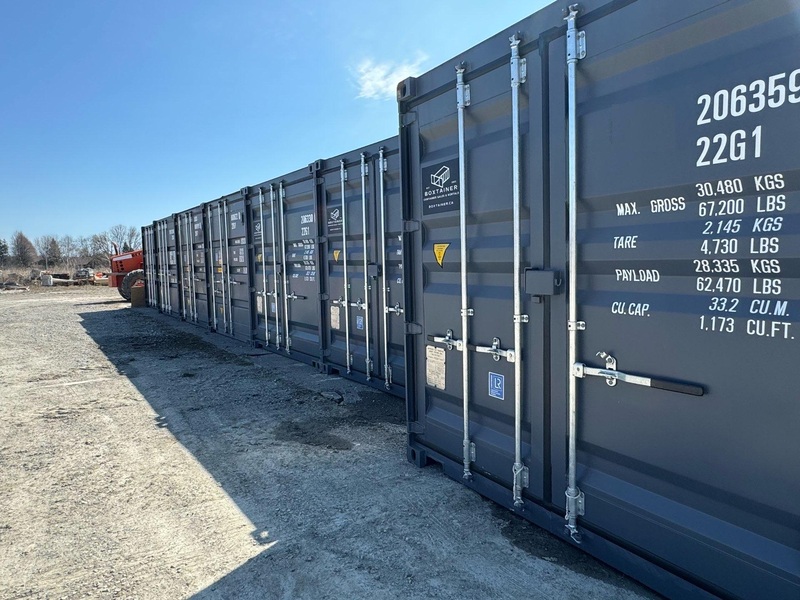
New containers, sometimes called one-trip units, offer a cleaner, more uniform product. They’re typically used once to ship goods from Asia, then sold. Structurally sound, minimal rust, tight door seals. For businesses that need a clean, presentable unit, or plan to modify the container, one-trip is often worth the premium.
Used containers are the more common choice for straightforward storage. They’re functional and priced lower, but condition varies. Buying from a reputable supplier matters here. A container described as “used” can mean anything from lightly worn to heavily dented, depending on who’s selling it; that sounds fine on paper, but the range in practice is wider than most buyers expect.
Buying for Business vs. Personal Use
Ontario businesses buying containers for storage, inventory overflow, or job site use tend to approach the decision differently than homeowners do. Multiple units are often needed, along with consistent condition grades and reliable delivery timelines. Individuals buying for personal storage or a backyard project are usually focused on one unit at a reasonable price.
Both groups are better served by working with a supplier that’s clear about what’s being sold. Containers for sale through established Ontario suppliers are generally accompanied by better condition documentation and more predictable delivery. That matters more than it might seem, sometimes, when a delivery is being coordinated around a business schedule.
Modifications and Custom Builds
Some buyers aren’t just looking for storage. Custom container builds, whether for offices, workshops, or retail spaces, are increasingly common in Ontario. These projects add significant cost beyond the base container price.
Modifications like roll-up doors, windows, insulation, electrical, and HVAC can add anywhere from a few thousand to tens of thousands of dollars, depending on scope. The container itself is often the least expensive part of a custom build. That’s usually where it clicks for buyers who come in expecting a simple purchase and end up planning a full build-out, over time realizing the container was just the starting point.
Renting vs. Buying in 2026
Not every situation calls for a purchase. Containers for rent are a practical option for seasonal storage, construction projects, or temporary overflow needs. Monthly rental rates in Ontario are generally quoted from $100 to $250 or more per month, depending on size and location.
Over a 12-month period, renting can approach or exceed the cost of buying a used unit. So for longer-term needs, buying usually makes more financial sense. For shorter windows, capital outlay is avoided, along with the eventual challenge of reselling. The right answer depends on how long the container is actually needed and what the budget allows. Probably enough said on that.
Getting Accurate Pricing from BOXTAINER
General ranges only go so far. The most reliable way to get an accurate number for a specific situation is to connect directly with a supplier who knows the Ontario market. BOXTAINER works with businesses and individuals across Ontario, including the Niagara storage market, and containers for sale and containers for rent are offered with clear pricing and dependable delivery.
For current pricing on 20-foot and 40-foot units, new and used, and to get a delivery quote for your location, visit BOXTAINER’s website at boxtainer.ca.
Mini-FAQ
Q: What’s the difference in price between a 20-foot and 40-foot container?
Generally, a 40-foot container is priced roughly 30 to 50 percent higher than a comparable 20-foot unit. That said, the gap tends to narrow when delivery is factored in, since a 40-foot container isn’t always twice the cost to ship. Worth knowing before bigger is assumed to mean a much bigger total expense.
Q – Does container condition really affect the price that much?
It does, more than most buyers expect. A wind-and-watertight (WWT) used container might be priced $500 to $1,500 less than a one-trip unit in the same size. One-trip containers are essentially new, having been used only once to ship goods from overseas. That still surprises people.
Q: Are there extra costs beyond the container purchase price?
Fair point to raise. Delivery is the most common added cost, and it’s often quoted separately. Site preparation, permits for certain uses, and modifications like shelving, vents, or doors are also priced on top. In many cases, the base container price is just the beginning of the total budget.
Q: Is renting a container sometimes a better option than buying?
For shorter-term needs, containers for rent can work out to be more cost-effective than buying outright. If the need is seasonal or project-based, upfront capital is avoided, along with the eventual resale hassle. Depends entirely on how long the container is actually needed.