What Actually Happens on Delivery Day
On delivery day, the truck driver conducts an initial assessment of the approach path, entrance width, and ground firmness before starting the offloading procedure. Smooth offloading depends entirely on proper site preparation and accurate pre-delivery details. Delivery times vary based on site complexity, and additional waiting fees apply if unloading is delayed beyond the allocated window.
Understanding the Truck and Equipment
Container transport requires specific commercial delivery vehicles tailored to unit length. Standard 20′ containers are delivered using flatbed tilt-and-load trucks. In contrast, 40′ standard and 40′ High Cube containers require longer, heavier Landoll-style tilt trailers. The truck and trailer combination requires significantly more room to maneuver than the container itself. Specialized crane placement is not standard and must be arranged separately for an additional fee. Explore our container rentals or check our containers for sale to review available transport options.
Site Access: The Detail That Trips People Up
Sufficient clearance is the single most critical factor during delivery. A 20′ container requires roughly 70–80 ft of straight clearance for the tilt-and-load truck to pull forward. A 40′ container needs 110–130 ft of straight approach, along with an entrance width of approximately 24 ft to clear turns. Overhead obstacles like utility wires, tree branches, and building eaves require ample vertical clearance. When site constraints or turning radii are uncertain, customers are encouraged to submit site photos, video walkthroughs, or marked satellite photos to our contact page for pre-delivery review.
Ground Conditions and Why They Matter
Containers must settle on a firm, level surface—such as asphalt, concrete, or compacted crushed stone pad. Soft grass, mud, or uncompacted dirt cause the heavy unit to sink unevenly, leading to frame racking and bound doors. Wood or concrete blocking under the corner castings may be used to assist with elevation or slight unevenness. However, blocking is not required for every delivery, nor is it automatically provided by delivery drivers.
A Quick Story From the Field
Recent site delivery notes from a commercial job in Southern Ontario illustrate proper offloading dynamics:
- 20ft Standard Container Delivery (Flatbed Tilt-and-Load)
A 20′ unit was delivered using a standard single-axle tilt-and-load flatbed truck. The driver reversed directly onto a compacted gravel pad, tilted the bed, and slid the rear corner castings onto the ground while pulling forward smoothly.
- 40ft High Cube Container Delivery (Landoll Trailer)
A 40′ High Cube container required a full-length tractor and Landoll tilt-n-load trailer. Due to the overall rig length, the driver utilized 125 ft of straight driveway approach to position the rear doors precisely where requested.
What Should Be Done Before the Truck Arrives
Before the delivery vehicle arrives, customers should complete the following checklist:
- Clear driveways and access lanes of parked cars, equipment, and low branches.
- Verify ground stability (concrete, asphalt, or compacted gravel pad ready).
- Check vertical clearance for overhead power lines or structure overhangs.
- Confirm door orientation selection (Doors to CAB vs. Doors to REAR).
Ensure an authorized representative is on-site to direct positioning.
Placement and Final Positioning
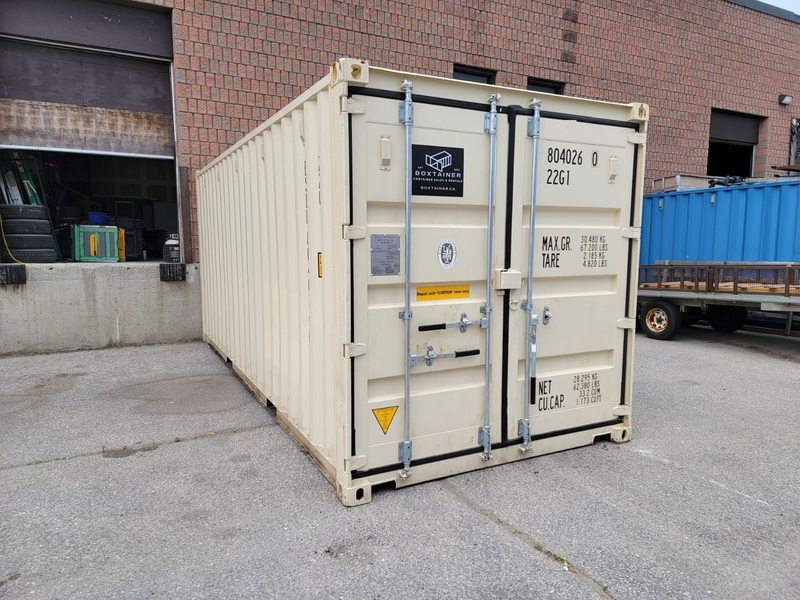
Because containers slide straight off the rear of the trailer, door orientation must be determined before loading the truck. We utilize clear industry terminology: Doors to CAB (doors face forward toward truck cab, setting down last) or Doors to REAR (doors face trailer rear, setting down first). For modified containers featuring side man-doors, customers must also specify whether the man-door faces driver side or passenger side prior to dispatch. Final positioning is guided by driver safety and access limits.
Working With a Supplier Who Knows Ontario
Boxtainer Inc. delivers tailored container solutions across Ontario from our head office and yard operations anchored in Niagara. Customers are welcome to visit our Niagara Falls yard by appointment to inspect and select available inventory. Customer self-pickups are not permitted; all deliveries are arranged through our transport network. Quotations are customized based on unit selection, delivery location, and specific transportation requirements rather than broad market averages.
We supply New One-Trip units and Used Cargo Worthy containers. Our Used Cargo Worthy containers are inspected to ensure they are wind- and watertight with intact door seals and solid floors, though normal cosmetic wear (dents, surface rust, paint touch-ups) is expected. Note that we do not provide export or CSC certifications for ocean shipping. Rental agreements operate on a calendar month schedule, billed on the 1st of each month without prorating or early-return credits, with separate freight charges for delivery and pickup.
FAQ
Q: Does someone need to be on-site during delivery?
Yes, having an authorized customer representative on-site is strongly recommended. Your representative confirms placement boundaries, verifies gate access, and reviews positioning with the driver before offloading. Note that repositioning after the container has been set down may not be feasible or could incur additional service charges.
Q – What kind of truck is used for container delivery?
Equipment selection depends directly on container size. Standard 20′ containers are typically delivered using tilt-and-load flatbed trucks, whereas 40′ standard and 40′ High Cube containers require larger Landoll-style equipment. Roll-off equipment is not used universally for all sizes. Crane placements or off-angle sets require separate arrangements and extra costs.
Q: What if my driveway isn’t wide enough?
If an entrance lacks sufficient width or turning room, alternative drop locations must be evaluated for ground stability, clear access, and legal permissions. Containers cannot automatically be placed on public roadways or neighboring properties. If standard delivery is unfeasible, our team will communicate available options prior to dispatch.
Q: Does the ground need to be level?
Yes. Delivery sites require a firm, level surface—such as concrete, asphalt, or compacted crushed stone—to ensure structural squareness and easy door operation. Grass, mud, and soft ground are unviable. Blocking may be placed under corner castings if site conditions demand it, but blocking is not mandatory for every site nor automatically supplied by drivers.